
How to Rescue a Scorched Pan with Baking Soda and Vinegar
Did you burn rice to the bottom of your favorite pot? Don't throw the pan away and don't scrub until your arms ache. Let a classic chemical volcano do the heavy lifting.
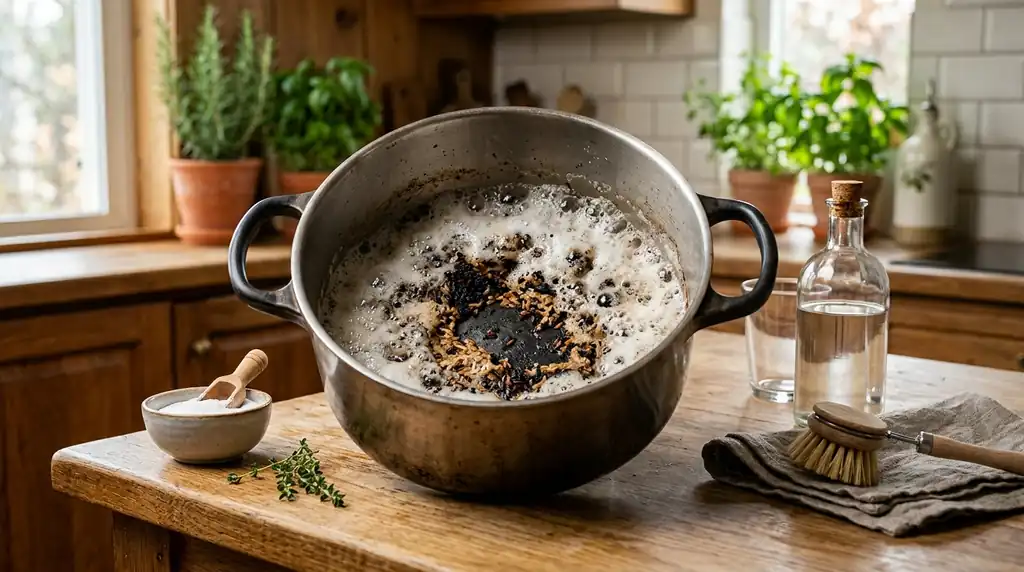
The Nightmare of the Burnt Pot
It is a sickening realization: you get distracted for five minutes while cooking oatmeal, rice, or a thick tomato sauce, and you suddenly smell the acrid stench of burning carbon. You look in the pot to find a thick, black, concrete-like layer of scorched food permanently welded to the bottom of your expensive stainless steel or enamel cookware.
Your first instinct is usually to fill the sink with hot soapy water and attack the black crust with a wire scouring pad. This is a terrible idea. Not only will you exhaust yourself scrubbing for an hour, but aggressive wire pads will permanently scratch and ruin the finish of your pan, making food stick even worse in the future.
The Power of the Acid-Base Reaction
To remove a scorched carbon layer without scrubbing, you must break the chemical bonds holding the burnt food to the metal. You can do this by combining heat with a powerful acid-base chemical reaction.
- White vinegar contains acetic acid. Baking soda (sodium bicarbonate) is a powerful base.
- When combined, they violently react, creating rapidly expanding carbon dioxide gas (the classic elementary school volcano).
- When this reaction happens directly on top of a scorched stain, accompanied by boiling heat, the expanding gas bubbles literally lift the burnt carbon off the metal from the bottom up.
Step-by-Step Pan Rescue
This method works brilliantly on stainless steel, cast iron, and enameled cast iron (like Le Creuset). Do not use this method on non-stick Teflon pans, as the boiling process can degrade the chemical coating.
- Step 1: Remove the loose debris. Use a wooden spoon to gently scrape out whatever unburnt food you can. Leave the hard, black crust alone.
- Step 2: The Vinegar Bath. Place the scorched pan on the stove. Pour equal parts white vinegar and water into the pan until the black crust is completely submerged (usually about 1 cup of each).
- Step 3: The Boil. Turn the heat to high and bring the vinegar/water mixture to a rolling, violent boil. Let it boil for 3 to 5 minutes. The acidic heat will begin to soften the carbon.
- Step 4: Remove from heat. Turn the burner off completely and carefully move the pan to a cool burner or a trivet.
- Step 5: The Chemical Volcano. Immediately pour 3 to 4 generous tablespoons of baking soda directly into the hot vinegar water. Stand back slightly, as it will instantly fizz and erupt into a massive layer of foam.
- Step 6: Let it work. Leave the pan alone. Do not touch it until the fizzing stops completely and the liquid has cooled enough to touch safely (usually about 15 to 20 minutes).
- Step 7: The Wipe. Take a standard kitchen sponge (the non-scratch side) or a wooden spatula and gently wipe the bottom of the pan. The horrifying black crust will peel away from the metal in large, soft sheets, requiring practically zero elbow grease.
- Step 8: Wash normally. Dump the black sludge down the drain, and wash the pot normally with hot water and dish soap to reveal a pristine, undamaged surface.
By letting chemistry do the heavy lifting, you save your cookware from the trash can and your arms from exhaustion.