
Demystifying Soy Sauce: Light, Dark, and Sweet
If a Chinese recipe just says "soy sauce," it almost always means Light. Learn the crucial differences between Light and Dark soy sauce, and why mixing them up will ruin your stir-fry.
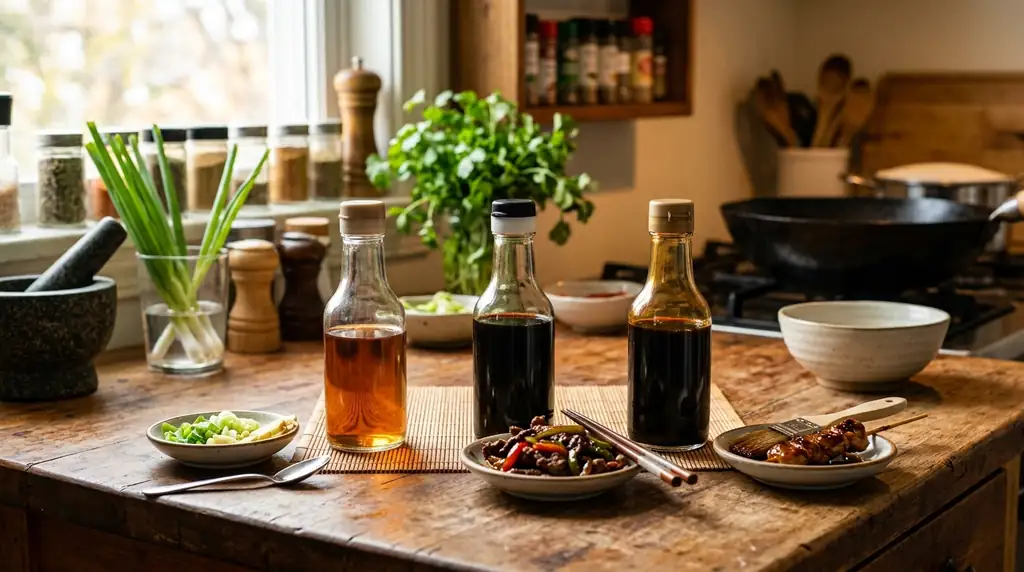
More Than Just Salty Water
In Western supermarkets, "soy sauce" is usually a single, homogenous product (like Kikkoman). However, authentic Chinese and Southeast Asian cooking relies on a deeply complex spectrum of fermented soy sauces, each serving a drastically different culinary purpose.
If an authentic recipe calls for "Dark Soy Sauce" and you use standard American supermarket soy sauce, your dish will lack the deep mahogany color and the rich, molasses-like depth required. Conversely, if you use Dark Soy Sauce as a dipping sauce for sushi, you will ruin the meal.
Light Soy Sauce (生抽 - Sheng Chou)
Do not confuse "Light" with "Low Sodium." In this context, Light refers to the color, not the salt content.
- Flavor: This is the workhorse of the Chinese kitchen. It is intensely salty, thin, fluid, and has a sharp, bright, umami-forward flavor. It is drawn from the first pressing of the fermented soybeans.
- Usage: If a Chinese recipe simply says "soy sauce," this is what they mean. Use it for general seasoning, marinades, stir-fries, and dipping sauces. It provides salt and flavor without drastically altering the color of the dish.
Dark Soy Sauce (老抽 - Lao Chou)
Dark soy sauce is aged much longer than light soy sauce and is frequently mixed with molasses or caramel coloring.
- Flavor: It is significantly less salty than light soy sauce. It is thick, viscous, slightly sweet, and has a deep, complex, almost earthy flavor.
- Usage: Dark soy sauce is primarily used for color. A single teaspoon will turn a pale chicken stir-fry into a rich, dark, appetizing mahogany color. It is mandatory for dishes like Red Braised Pork (Hong Shao Rou) or classic Beef and Broccoli. It is almost never used as a dipping sauce.
Other Notable Varieties
Beyond the Chinese staples, other Asian cultures have their own distinct variations.
- Japanese Shoyu (e.g., Kikkoman): Japanese soy sauces are typically brewed with a 50/50 ratio of soybeans to roasted wheat. This makes them slightly sweeter and more nuanced than Chinese light soy sauce (which uses much less wheat).
- Tamari: This is a specific type of Japanese soy sauce brewed with little to no wheat. It is thicker, richer, and less salty than standard Shoyu, and is the go-to gluten-free option.
- Indonesian Kecap Manis: This is a heavily sweetened soy sauce, reduced with palm sugar until it is thick and syrupy. It is the defining flavor of Nasi Goreng (Indonesian fried rice).
Keeping both a bottle of Light and Dark Chinese soy sauce in your pantry is the easiest way to instantly elevate your homemade stir-fries to restaurant quality.