
The Ultimate Eggshell Retrieval Hack
Stop chasing broken bits of eggshell around the bowl with your finger. Learn the scientific reason why using the shell itself is the fastest way to extract fragments.
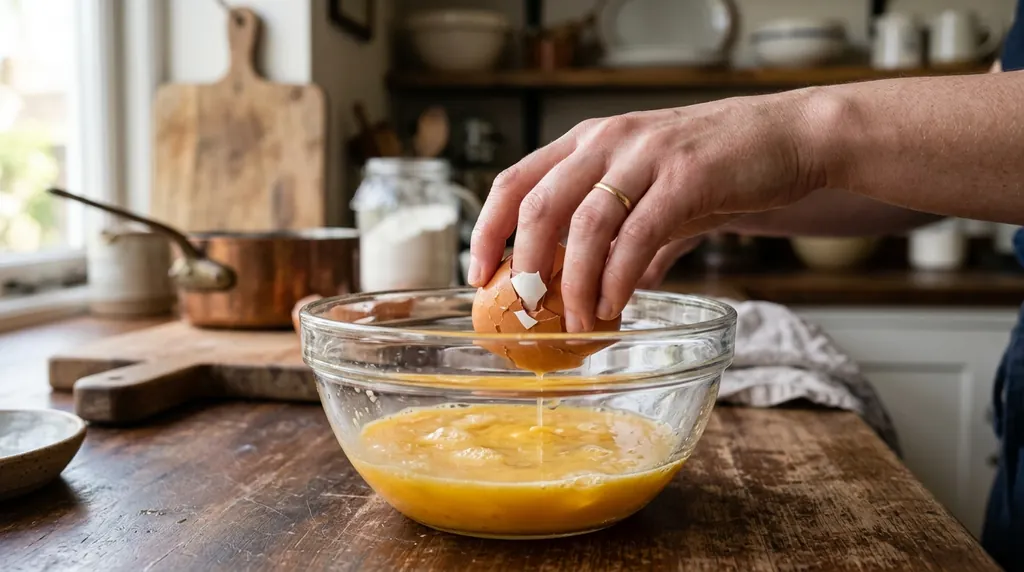
The Breakfast Frustration
You are cracking eggs into a bowl to make a scramble or a cake batter, and suddenly, a rogue shard of eggshell falls into the liquid. It sits there, mocking you. You reach your finger into the slimy egg white to grab it, but the shard seems to possess a mind of its own, constantly swimming away from your grasp.
Chasing an eggshell fragment with your finger or a metal spoon is an exercise in futility. The viscosity of the egg white acts like a force field, pushing the lightweight shell away before you can actually touch it. Plunging your fingers into raw eggs is also a hygienic concern.
The Physics of the Shell-on-Shell Hack
The absolute best tool for retrieving a broken piece of eggshell is the larger, intact half of the eggshell you are already holding in your hand.
- An eggshell has a razor-thin, incredibly sharp edge that easily slices through the thick, viscous proteins of the egg white.
- More importantly, the shell and the fragment are made of the exact same material (calcium carbonate). Because they possess the same surface tension, water affinity, and molecular structure, they naturally attract each other.
- When the sharp edge of the large shell touches the floating fragment, the fragment acts like a magnet, clinging instantly to the larger shell.
Step-by-Step Flawless Retrieval
This trick takes literal seconds and works flawlessly every single time.
- Step 1: Acknowledge the fragment. Do not panic or immediately stick your fingers into the bowl.
- Step 2: Hold on to the shell. Keep the larger, empty half of the cracked eggshell in your hand.
- Step 3: Wet the shell. (Optional but helpful) Run the edge of the large shell under cold water for one second, or simply ensure it is coated in the residual raw egg white.
- Step 4: The scoop. Use the large shell half like a tiny shovel. Submerge the sharp edge of the shell into the raw egg liquid directly next to the floating fragment.
- Step 5: The connection. Scoop underneath the fragment. Because the sharp edge slices through the egg white without creating a pressure wave, the fragment will not swim away.
- Step 6: The extraction. The fragment will aggressively stick to the inside of the larger shell. Simply lift the large shell out of the bowl, bringing the fragment with it.
Prevention is the Best Cure
While this hack is a lifesaver, changing how you crack eggs can prevent the issue entirely.
- Never crack an egg on the sharp edge of a bowl or a pan. The sharp edge drives shards of shell directly inward, piercing the yolk and ensuring fragments fall into the food.
- Always crack eggs on a perfectly flat surface, like the kitchen counter. This creates a clean, even fault line across the equator of the egg, keeping the membrane intact and preventing any shattering.
With the flat-surface cracking method and the shell-on-shell retrieval trick, you will never ruin a batch of cookies with a crunchy bite of calcium again.