
How to Make a Flawless Omelette
The classic French omelette is a masterclass in heat control and technique. Learn how to achieve a pale, delicate exterior with a creamy, custard-like center.
The Ultimate Test of a Chef
In the culinary world, particularly in classical French training, a chef's skill is often judged by their ability to make a simple omelette. It requires no fancy ingredients—just eggs, butter, salt, and pepper—but demands absolute mastery over heat and timing.
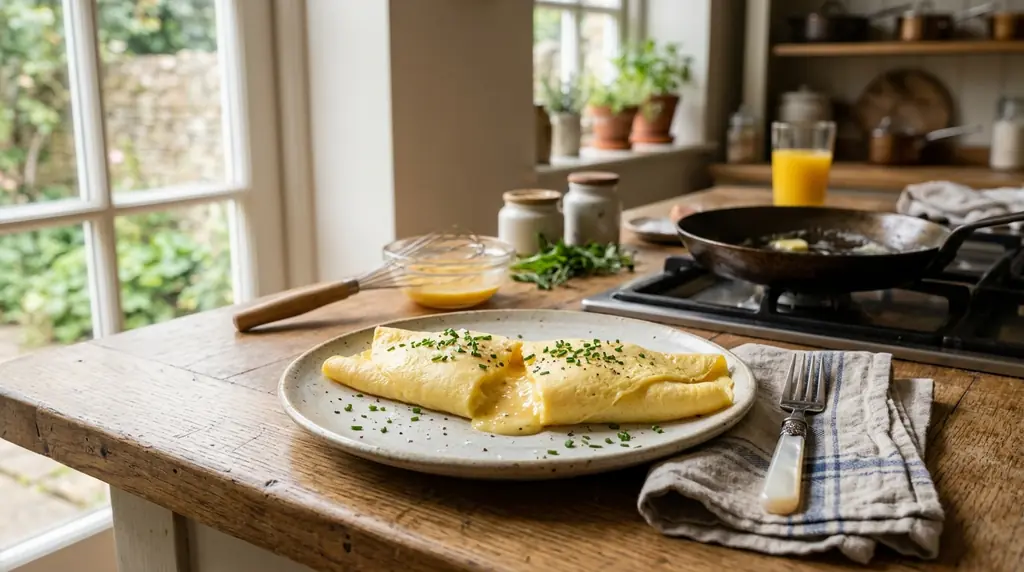
A classic French omelette is vastly different from the American diner-style omelette. It should have absolutely zero brown color on the outside (browning indicates tough, overcooked proteins). The exterior should be smooth and pale yellow, while the interior should remain incredibly moist, soft, and slightly runny, known as "baveuse."
The Tools for the Job
You cannot execute this technique with the wrong equipment. You need the right pan and the right utensil.
- You must use an 8-inch non-stick skillet. If the pan is too large, the eggs will spread too thin and overcook instantly. If it is not non-stick, the delicate eggs will tear.
- You need a heat-proof silicone spatula or a classic wooden fork. Avoid metal, which will scratch the pan, and avoid stiff plastic spatulas that cannot sweep the curves of the pan.
Step-by-Step Omelette Mastery
This entire process takes less than two minutes. Have a warm plate waiting, because an omelette waits for no one.
- Step 1: Crack 3 fresh eggs into a bowl. Season generously with salt and white pepper (black pepper leaves unsightly black specks in the yellow egg).
- Step 2: Whisk the eggs aggressively with a fork until the whites and yolks are completely homogenized into a uniform yellow liquid. Do not leave streaks of egg white.
- Step 3: Place the 8-inch non-stick skillet over medium heat. Add 1 tablespoon of unsalted butter.
- Step 4: As soon as the butter melts and begins to foam (do not let it turn brown), pour all the eggs into the center of the pan.
- Step 5: Immediately begin vigorously stirring the eggs in rapid, small circles with your spatula while simultaneously shaking the pan back and forth on the burner with your other hand. This creates tiny, delicate curds.
- Step 6: Use your spatula to constantly scrape down the sides of the pan, pushing the cooked edges back into the liquid center.
- Step 7: When the eggs look like a loose, wet scramble and the bottom is just barely set (this takes about 45 to 60 seconds), stop stirring. Use the spatula to smooth the eggs into an even layer.
- Step 8: Turn off the heat. If adding fillings (like cheese or herbs), place a very small amount in a line just off-center.
- Step 9: Tilt the pan away from you. Use the spatula to gently fold the top third of the omelette down over the center.
- Step 10: Hold the pan over your warm plate, tilt it further, and let gravity help you roll the omelette out of the pan so that it lands seam-side down on the plate, shaped like a beautiful, pale yellow cigar.
The Finishing Touch
Presentation matters. To give your omelette a glossy, professional finish, take a small piece of cold butter on a fork and run it lightly over the hot exterior of the plated omelette.
- Practice makes perfect. Do not be discouraged if your first few attempts end up as scrambled eggs. The coordination of shaking and stirring takes muscle memory.
- Heat control is everything. If the eggs sizzle violently when they hit the pan, it is too hot. If they sit there lifelessly, it is too cold.
Once you master this technique, you will possess one of the most elegant, impressive, and delicious breakfast skills in the culinary repertoire.