
Knife Skills 101: How to Hold a Chef's Knife
Master the 'pinch grip' and the 'claw hand' to slice, dice, and chop faster, safer, and with the precision of a professional chef.
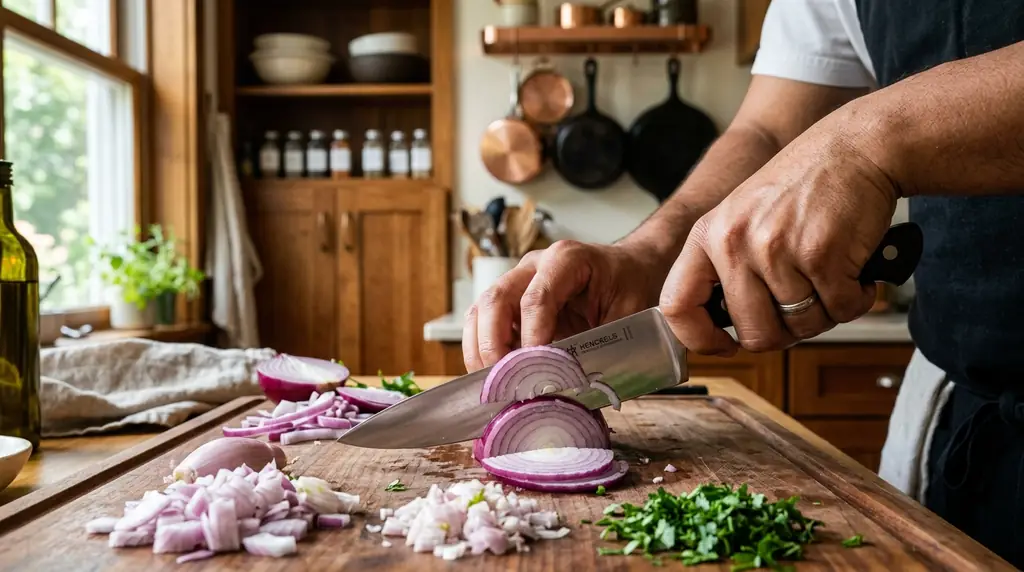
The Foundation of Kitchen Safety
A chef's knife is an extension of your arm in the kitchen. However, if you are holding it incorrectly, you are not only compromising your speed and precision but also putting yourself at serious risk of injury.
Most beginners naturally grip the handle with their entire fist, much like holding a hammer. This grip is unstable and forces your wrist to do all the work, leading to quick fatigue and wildly uneven cuts.
Step-by-Step: The Pinch Grip and Claw
To slice and dice like a professional, you must master two fundamental hand positions: the Pinch Grip for your dominant hand, and the Claw Hand for your guiding hand.
- Step 1: Open your dominant hand and rest the handle of the knife in your palm.
- Step 2: Slide your hand forward until your thumb and index finger are resting on the actual metal blade, just in front of the handle (the bolster).
- Step 3: Firmly pinch the metal blade with your thumb and index finger, then wrap your remaining three fingers loosely around the handle for support.
- Step 4: With your non-dominant hand, form a loose fist, resembling a bear claw.
- Step 5: Rest the tips of your fingers gently on the food you are cutting, curling your fingertips slightly inward toward your palm.
- Step 6: Rest the flat side of the knife blade directly against your knuckles. As you chop, slide your claw hand backward, using your knuckles as an immovable guide for the blade.
Common Mistakes to Avoid
It will feel awkward for the first few days, but retraining your muscle memory is absolutely essential for long-term culinary success.
- Avoid placing your index finger flat along the spine of the knife. This reduces lateral stability and forces your wrist into an unnatural angle.
- Never let your fingertips extend past your knuckles on your guiding hand.
- Let the weight and sharpness of the knife do the work; you should be guiding the blade in a rocking motion, not forcefully chopping down like an axe.
Once the pinch grip and claw become second nature, your prep time will be cut in half, and your vegetable cuts will be uniform, ensuring everything cooks evenly in the pan.