
The Ultimate Guide to Salt: Kosher, Table, and Sea Salt
All salt is sodium chloride, but swapping them 1-to-1 in a recipe will ruin your food. Understand the massive differences in density and usage.
The Most Important Ingredient
Salt is the single most important ingredient in the kitchen. It does not just make food salty; it suppresses bitterness, enhances sweetness, and fundamentally alters the texture of proteins. However, not all salt is created equal.
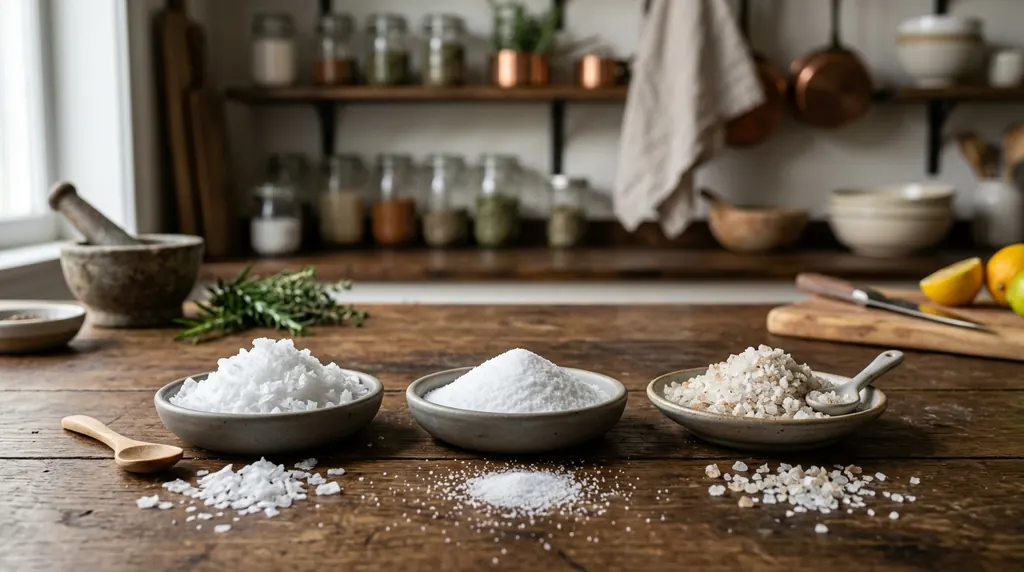
If a recipe calls for "1 tablespoon of kosher salt" and you use 1 tablespoon of table salt, your dish will be completely ruined and inedibly salty. This is because different salts are formed into different crystal shapes, drastically affecting how much actual sodium fits into a measuring spoon.
Table Salt (The Dense Powder)
Table salt is mined from underground salt deposits and heavily refined.
- Texture: It consists of tiny, perfectly cubic, incredibly dense crystals.
- Additives: It almost always contains anti-caking agents (to prevent clumping in high humidity) and is frequently fortified with iodine (which can leave a faint metallic aftertaste in delicate dishes).
- Usage: Because it is so dense, a tablespoon of table salt contains twice as much sodium as a tablespoon of kosher salt. It is best used for baking (where precise volumetric measuring is required and the small crystals dissolve quickly) or heavily salting pasta water.
Kosher Salt (The Chef's Standard)
Kosher salt is the absolute standard in professional kitchens, and it should be the standard in yours.
- Texture: The crystals are large, flat, and flaky. This coarse texture makes it incredibly easy to pinch between your fingers, giving you immense physical control over how much you are sprinkling over a steak.
- Density: Because the flakes are large and irregular, they don't pack tightly into a measuring spoon. It is much less dense than table salt, meaning it is much harder to accidentally over-salt your food.
- Warning: There are two main brands of Kosher salt (Diamond Crystal and Morton). Diamond Crystal is extremely light and hollow, while Morton is denser. Many professional recipes specifically call for Diamond Crystal.
Sea Salt (The Finisher)
Sea salt is evaporated directly from ocean water.
- Characteristics: It contains trace minerals (like magnesium and potassium) from the ocean, which can impart subtle, complex flavors and colors (like pink Himalayan or grey Celtic salt).
- Fleur de Sel / Maldon: These are ultra-premium, hand-harvested flaky sea salts. They form beautiful, hollow pyramids that shatter on the tongue.
- Usage: Never dissolve expensive sea salt into a soup or pasta water; you are literally pouring money down the drain. Reserve it strictly as a "finishing salt." Sprinkle it over a sliced steak, a chocolate chip cookie, or a sliced tomato right before eating to provide a burst of crunch and flavor.
By understanding the density and purpose of these three salts, you gain the most fundamental seasoning control in the culinary arts.