
Hard Italian Cheeses: Parmesan vs. Pecorino
They both look like hard, crumbly wedges, but swapping them carelessly will ruin a classic carbonara. Learn the profound differences between Italy's two most famous grating cheeses.
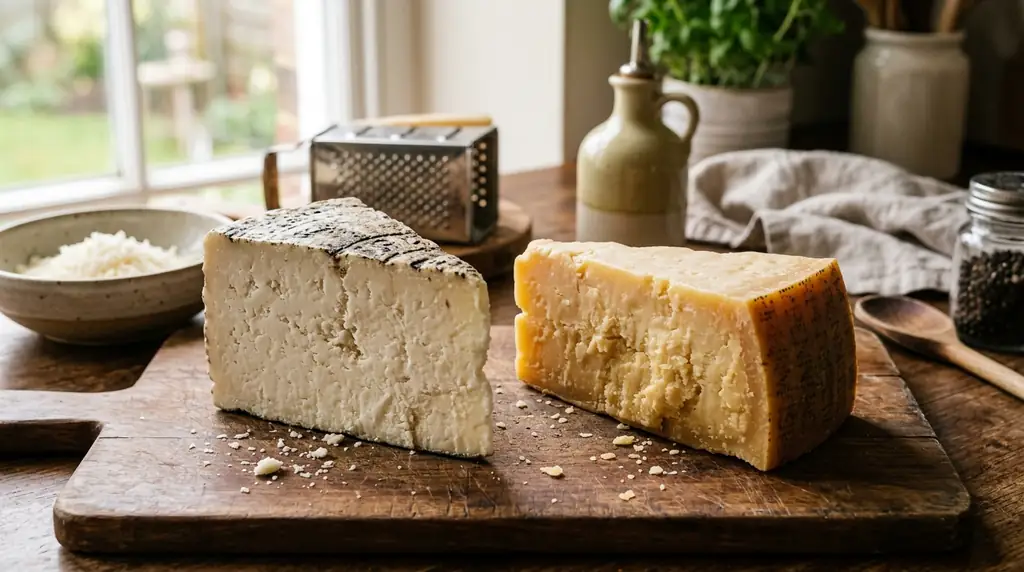
The Green Can Illusion
For many Americans, "Parmesan" refers to the pre-grated, powdery substance sold in green cardboard tubes in the pasta aisle. That product is heavily mixed with cellulose (wood pulp) to prevent clumping and bears almost zero resemblance to authentic Italian grating cheeses.
In authentic Italian cuisine, hard cheeses are not just a garnish; they are structural ingredients that provide the salt, the fat, and the umami backbone of the entire sauce. The two titans of this category are Parmigiano-Reggiano and Pecorino Romano.
Parmigiano-Reggiano (The King of Cheese)
If a recipe calls for Parmesan, this is what they mean. It is tightly regulated by Italian law (DOP status).
- The Milk: It is made exclusively from unpasteurized Cow's milk in a very specific region of Northern Italy.
- The Aging: It must be aged for a minimum of 12 months, though 24 or 36 months is common. During this long aging process, the cheese loses moisture, becoming hard and crumbly.
- The Flavor: It is deeply savory, nutty, slightly sweet, and relatively mild in its saltiness. It is famous for the tiny, crunchy white crystals (tyrosine amino acids) that develop during aging.
- Usage: It is incredibly versatile. It is the classic finishing cheese for almost all Northern Italian pasta dishes (like Bolognese or Alfredo), fantastic shaved raw over salads, and the leftover hard rinds are highly prized for dropping into soups to add umami.
Pecorino Romano (The Sharp Southern Bite)
Pecorino is an entirely different beast.
- The Milk: It is made exclusively from Sheep's milk (the word "pecora" means sheep in Italian).
- The Aging: It is generally aged for a much shorter period (usually 5 to 8 months).
- The Flavor: Because it is sheep's milk, and because it is aggressively salted during production, Pecorino Romano is violently sharp, incredibly salty, grassy, and has a distinct, pungent "funk" that cow's milk lacks.
- Usage: This is the cheese of Southern Italy and Rome. It is absolutely mandatory for the four classic Roman pastas: Carbonara, Cacio e Pepe, Amatriciana, and Gricia. If you try to make a Cacio e Pepe with Parmesan, it will lack the aggressive, sharp bite that defines the dish.
The Blending Strategy
Because Pecorino Romano is so salty and pungent, using it 100% can sometimes overwhelm a delicate sauce or a modern palate.
- A very common chef's trick (even in Italy) is to blend them. Using a 50/50 mix of Parmigiano-Reggiano and Pecorino Romano provides the nutty sweetness of the cow's milk with the sharp, salty punch of the sheep's milk.
Always buy wedges of real cheese and grate them yourself. The flavor difference compared to the green tube is immeasurable.