
Reviving Wilted Vegetables with Ice Water
Don't throw away sad, droopy celery or limp lettuce. Learn how to harness the power of osmosis to bring your vegetables back from the brink of the compost bin.
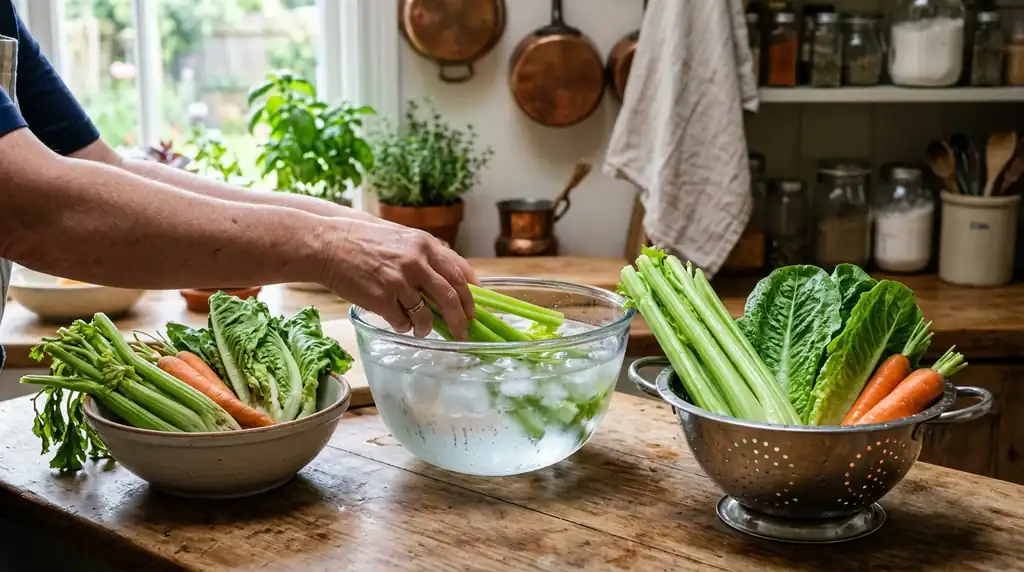
The Science of the Sag
You reach into the crisper drawer to make a salad, only to discover your romaine lettuce is limp, your carrots are bendy, and your celery stalks look like sad rubber bands. Your first instinct might be to throw them away, assuming they have spoiled.
However, limpness does not mean the vegetable has rotted. Vegetables are primarily made of water held inside rigid cell walls. This internal water pressure is called "turgor." When a vegetable sits in a dry refrigerator, that water slowly evaporates through the skin. As the cells lose water, the turgor pressure drops, and the vegetable goes limp.
The Osmosis Hack
Because the vegetable is simply dehydrated, the process is entirely reversible. By utilizing osmosis—the natural movement of water through a semi-permeable membrane from an area of high concentration to an area of low concentration—you can force water back into the plant cells.
- You must use incredibly cold water. Warm water will encourage bacterial growth and accelerate rot.
- Ice water shocks the plant cells, causing them to absorb the liquid rapidly and lock it in, returning the vegetable to its original, crisp, snappy texture.
Step-by-Step Revival Process
This hack works miraculously on almost all leafy greens, root vegetables, and stalky vegetables. It does not work on vegetables that have already turned slimy or black (which indicates rot).
- Step 1: Assess the damage. If the lettuce is just limp and slightly wrinkled, it can be saved. If it is slimy, smells bad, or has black spots, throw it out.
- Step 2: Prepare the bath. Fill a large mixing bowl, a clean sink, or a salad spinner bowl halfway with cold tap water.
- Step 3: Add the ice. Dump two or three large handfuls of ice cubes into the water to drop the temperature to near freezing.
- Step 4: Prep the vegetables. Cut the bottom half-inch off the stems of celery, broccoli, or asparagus to expose fresh, unhealed tissue (acting like a straw). For lettuce, separate the leaves.
- Step 5: Submerge the vegetables completely in the ice water. You may need to place a heavy plate on top of them to keep them underwater.
- Step 6: Wait patiently. Let them soak for 15 to 30 minutes. Extremely sad root vegetables (like bendy carrots) might need up to an hour.
- Step 7: Remove and dry. Pull the revived, perfectly crisp vegetables out of the bath. Dry them thoroughly in a salad spinner or with paper towels before using, as wet greens will repel oil-based dressings.
This simple trick saves hundreds of dollars a year in food waste and ensures your salads always have a satisfying crunch.