
Demystifying Yeast: Fresh, Active Dry, and Instant
Yeast is a living organism, and how it is processed determines how you must wake it up. Learn the differences between the three main types of baker's yeast.
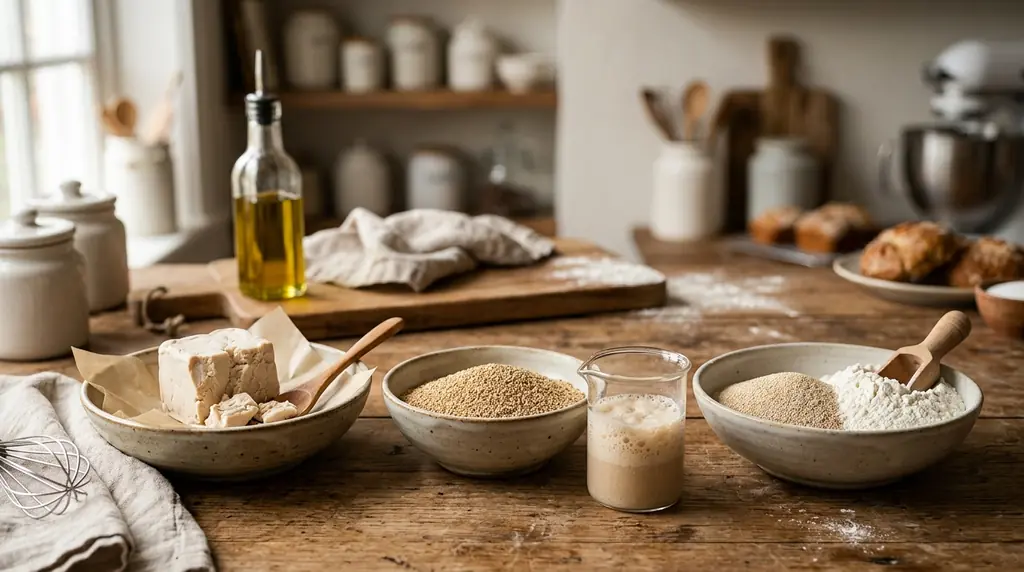
The Living Leavener
Unlike baking soda, which is a simple chemical reaction, yeast is a living, single-celled fungus. When yeast consumes sugars and starches in flour, it excretes carbon dioxide gas (which makes the bread rise) and alcohol (which gives bread its complex, fermented flavor).
For thousands of years, bakers had to rely on wild yeast captures (sourdough starters). Today, commercial yeast is highly purified and concentrated, but it is sold in three distinct formats. Understanding how to handle each format is the difference between a soaring loaf of artisan bread and a dense, flat brick.
Fresh Yeast (Cake Yeast)
This is yeast in its most active, raw, and perishable state.
- Texture: It comes in soft, crumbly, pale beige blocks that feel like putty. It is highly perishable and must be kept refrigerated, usually lasting only two to three weeks.
- Usage: Because the yeast is fully alive and active, you do not need to "proof" or wake it up. You simply crumble it directly into the dry flour or dissolve it in the liquid.
- Pros/Cons: It provides an incredibly robust, sweet, yeasty flavor, which is why it is preferred by professional European bakeries. However, its short shelf life makes it highly impractical for the casual home baker.
Active Dry Yeast (The Granules)
Developed during WWII for the military, this yeast has been dehydrated to vastly extend its shelf life.
- Texture: It consists of large, round granules. The dehydration process creates a thick shell of dead yeast cells encapsulating the dormant live cells inside.
- The Mandatory Proof: Because of this thick shell of dead cells, you CANNOT add Active Dry Yeast directly to dry flour. It will not dissolve, and your bread will have hard little granules of yeast throughout it. You MUST "proof" or "bloom" it first.
- How to Proof: You must dissolve the granules in warm water (between 100°F and 110°F) with a pinch of sugar, and let it sit for 10 minutes until it becomes cloudy and foamy. This strips away the dead cells and wakes up the live ones.
Instant Yeast (Rapid Rise)
This is a modern marvel of genetic selection and gentler dehydration.
- Texture: The granules are much smaller and finer than Active Dry Yeast. The dehydration process is gentle, meaning there is no thick shell of dead cells.
- Usage: Because it is so fine and lacks the dead shell, it dissolves instantly in the moisture of the dough. You do NOT need to proof or bloom it in warm water. You can mix it directly into your dry flour.
- Pros: It acts much faster than Active Dry yeast, often reducing rising times by 20% to 30%. It is highly reliable and has a long shelf life. For the modern home baker, Instant Yeast is unequivocally the best choice.
Conversion Rules
You can easily substitute one for the other if you adjust the amounts.
- If a recipe calls for 1 packet (2 1/4 teaspoons) of Active Dry Yeast, you can substitute a slightly smaller amount (about 1 3/4 teaspoons) of Instant Yeast.
- If you are substituting Fresh Yeast for Dry, you generally need to use three times as much Fresh Yeast by weight.
By switching to Instant Yeast and keeping it in the freezer (where it will live for years), you remove the stress and unpredictability from homemade bread.