
Understanding Rice Varieties: Basmati, Jasmine, and Arborio
Rice is not just a bland starch; it is a diverse grain with distinct starch profiles. Learn why you can't make risotto with jasmine, or sushi with basmati.
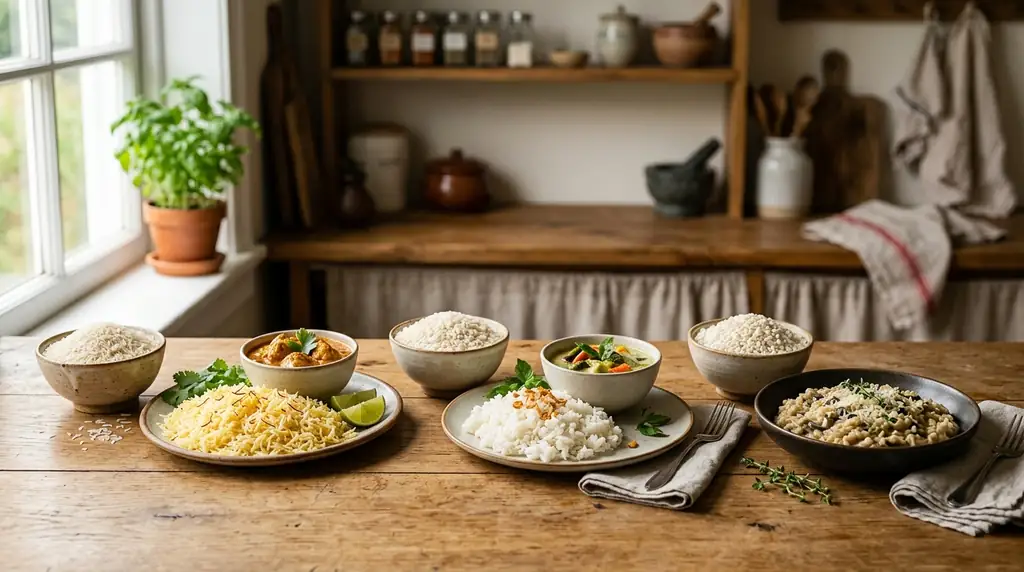
The Starch Spectrum
To a novice cook, rice is simply a white grain you boil in water until soft. However, substituting one type of rice for another in a specific cultural dish will guarantee failure. You cannot make Italian Risotto with Indian Basmati rice, and you cannot make Japanese Sushi with American long-grain white rice.
The defining characteristic of all rice is its starch profile. Rice contains two distinct types of starch: amylose and amylopectin. Amylose is a long, straight molecule that does not gelatinize easily. Amylopectin is a highly branched molecule that becomes incredibly sticky and creamy when heated. The ratio of these two starches dictates the texture of the cooked grain.
The Long-Grain Aromatics (Basmati and Jasmine)
These grains are long, slender, and high in amylose. When cooked, the grains remain distinct, dry, and fluffy, completely refusing to stick together.
- Basmati: The king of Indian and Middle Eastern cooking. It undergoes a unique aging process (often for a year or more) to dry it out completely. When cooked, it elongates significantly and produces a deeply nutty, popcorn-like aroma. It is the mandatory choice for Biryani and pilafs.
- Jasmine: The staple of Southeast Asian (Thai and Vietnamese) cooking. It is slightly shorter and plumper than Basmati, and has slightly more amylopectin, meaning it is just sticky enough to be easily eaten with chopsticks. It possesses a beautiful, floral, slightly sweet aroma.
The Short-Grain Stickies (Sushi Rice)
These grains are short, squat, and packed with amylopectin.
- Japanese Short-Grain (Sushi Rice): When cooked, the high amylopectin content causes the grains to cling together tightly in a cohesive mass, while still retaining a firm, distinct bite in the center. This stickiness is absolutely essential for forming sushi rolls or nigiri, as long-grain rice would simply fall apart.
- Glutinous Rice (Sticky Rice): Do not let the name fool you; it contains zero gluten. It is almost 100% amylopectin. When steamed (never boiled), it fuses into a dense, chewy, almost solid block. It is used in Thai mango sticky rice and Chinese dumplings (Zongzi).
The Medium-Grain Creamers (Arborio and Carnaroli)
These Italian rices exist in the middle, and are bred for a very specific culinary technique.
- Arborio (and the superior Carnaroli): These grains have a hard, chalky center (amylose) and a soft, starch-rich exterior (amylopectin).
- When you make Risotto, you slowly stir hot broth into the rice. The constant friction rubs the amylopectin off the exterior of the grain, turning the broth into a rich, velvety, creamy sauce, while the hard amylose center remains al dente (firm to the bite).
By treating rice not as a monolith, but as a diverse family of specific tools, you respect the culinary traditions they belong to.