
Understanding Salt: Kosher vs Table vs Sea Salt
Not all salt is created equal. Learn why chefs prefer Kosher salt, when to use delicate flaky sea salt, and why table salt can easily ruin a recipe if not measured correctly.
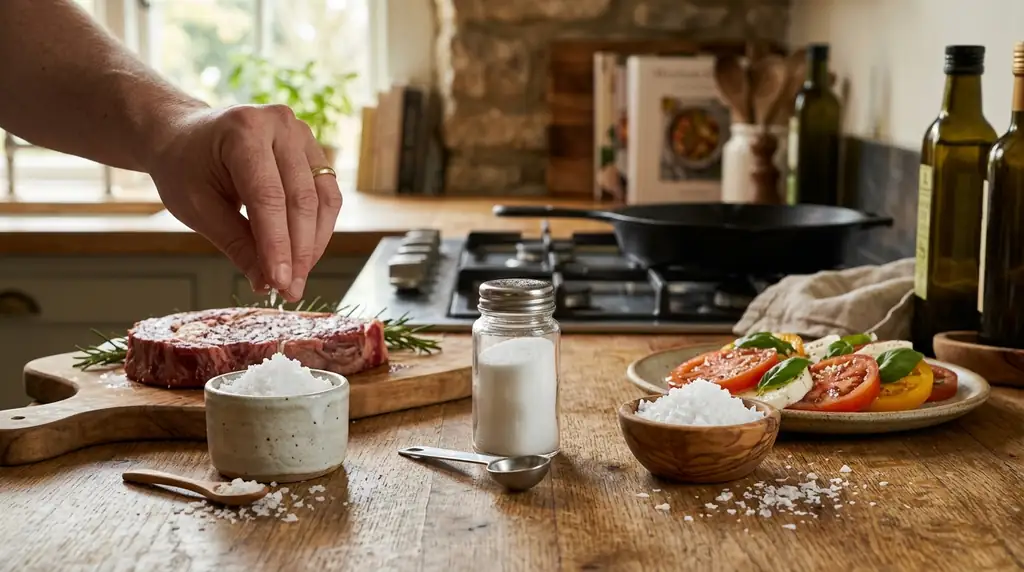
Why Salt Types Matter
Salt is the single most important ingredient in any kitchen. It reduces bitterness, enhances sweetness, and amplifies the natural flavor profile of whatever you are cooking. But not all salt is created equal.
If you walk into any professional kitchen in the world, you will not find the tiny cardboard cylinders of iodized table salt. You will find massive boxes of Kosher salt and delicate jars of flaky sea salt. Understanding the mechanical differences between these salts is essential.
Understanding the Varieties
The chemical makeup (Sodium Chloride) is largely the same, but the shape, density, and size of the crystals dictate how they should be used in cooking.
- Table Salt: These are tiny, dense, uniform cubes. Because it is so dense, a tablespoon of table salt is incredibly heavy and intensely salty. It also often contains iodine (which can taste metallic) and anti-caking agents to prevent clumping.
- Kosher Salt: These crystals are large, coarse, and irregularly shaped (like tiny pyramids). It is much less dense than table salt. Because the flakes are large, you can easily pick it up and sprinkle it evenly with your fingers. This is the universal standard for seasoning meat and vegetables during the cooking process.
- Flaky Sea Salt: Examples include Maldon or Fleur de Sel. These are large, delicate, hollow pyramid structures. They are expensive and fragile.
Step-by-Step Usage Guide
Here is exactly when and how to deploy each type of salt in your kitchen.
- Step 1: Ban table salt from your savory cooking. It is too easy to accidentally over-salt a dish because it is so dense. Save it strictly for baking recipes that specifically call for it.
- Step 2: Use Kosher salt for 95% of your cooking. Keep a small bowl (a salt cellar) next to your stove. Use your fingers to grab a pinch, and season your food from high up (about 12 inches above the pan) to ensure an even shower of seasoning.
- Step 3: Never cook with flaky sea salt. It dissolves in heat and moisture, defeating its purpose. Use it exclusively as a "finishing salt."
- Step 4: Right before serving a finished dish (like a sliced steak, a fresh tomato salad, or a chocolate chip cookie), sprinkle flaky sea salt over the top. It provides a satisfying, crunchy texture and a bright pop of salinity.
Always read your recipes carefully. If a recipe calls for 1 tablespoon of Kosher salt and you substitute 1 tablespoon of table salt, you will essentially be doubling the sodium, ruining the dish.