
Essential Wok Skills: Achieving Wok Hei
The elusive 'breath of the wok' defines great Chinese stir-fry. Discover how high heat, constant tossing, and oil droplets interacting with flame create this smoky, charred flavor profile.
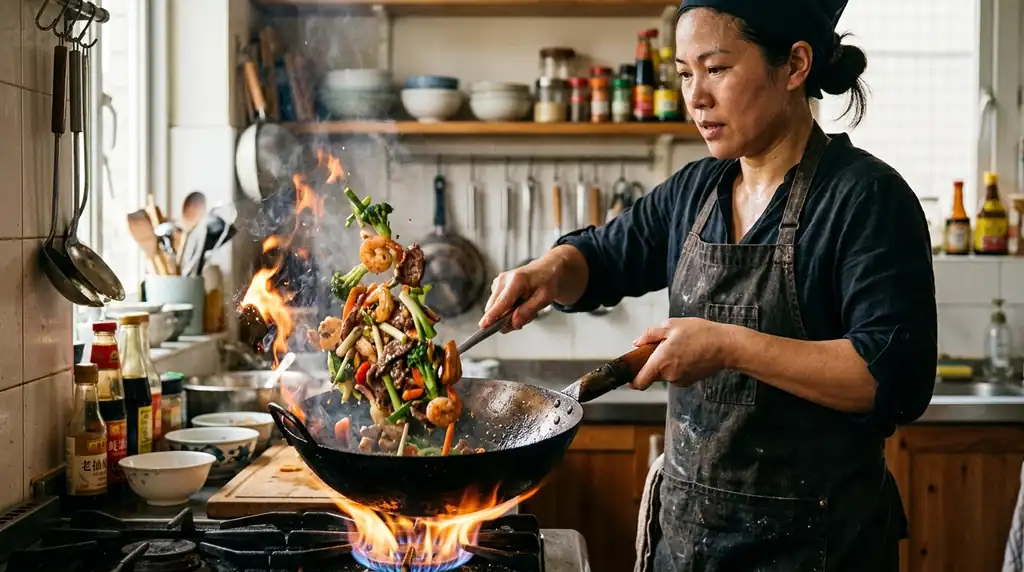
The Elusive Breath of the Wok
If you have ever eaten a stir-fry at a high-end Chinese restaurant, you have likely noticed a distinct, complex flavor profile that is nearly impossible to replicate at home. It is a smoky, intensely charred, almost metallic essence that permeates the noodles and vegetables.
This flavor is known in Cantonese as "Wok Hei," which translates poetically to "the breath of the wok." It is the holy grail of Chinese cooking, and it requires specialized equipment, immense heat, and years of physical technique to master.
Step-by-Step: The Science of Wok Hei
Wok Hei is not an ingredient you can buy in a bottle. It is the result of rapid, intense chemical reactions occurring at temperatures exceeding 600°F (315°C).
- Step 1: The Equipment. Wok Hei requires a well-seasoned carbon steel wok. Non-stick pans cannot handle the heat, and cast iron is too heavy to toss. You also need a commercial wok burner capable of producing a massive, jet-engine-like flame.
- Step 2: Extreme Heat. The wok is heated until it is literally smoking. Cold oil is added right before the ingredients to prevent it from degrading into acrid smoke.
- Step 3: The Toss. This is where the magic happens. The chef aggressively pushes the wok forward and pulls it sharply back, launching the food into the air above the rim of the pan.
- Step 4: Combustion. As the food flies into the air, microscopic droplets of oil are aerosolized. These tiny oil droplets catch fire in the massive gas flame curling up the sides of the wok.
- Step 5: The Sear. This brief, explosive fireball surrounds the airborne food, instantly searing the surface and imparting that signature smoky, charred flavor without actually burning the ingredients.
- Step 6: Rapid Evaporation. The intense heat instantly evaporates the surface moisture of the vegetables, concentrating their flavors and preventing them from boiling in their own juices.
Replicating it at Home
A standard home stove simply does not have the BTU output to generate true Wok Hei, but you can cheat the system to get surprisingly close.
- Cook in tiny batches. If you overload a home wok, the temperature drops, and your food will steam. Cook your meat, remove it, cook your veggies, remove them, and combine at the very end.
- Use a kitchen blowtorch. As you stir-fry the food in your pan, carefully use a culinary torch to blast the surface of the ingredients from above. This mimics the airborne combustion of oil droplets.
- Pre-heat your carbon steel or cast-iron skillet until it is terrifyingly hot before adding any food.
While true Wok Hei is a masterclass in fire manipulation, understanding the science behind it will instantly improve the quality of your home stir-fries.