
How to Fold Egg Whites into Batter
The secret to incredibly light, airy soufflés and chiffon cakes lies in a delicate mixing technique called folding. Learn how to combine mixtures without destroying the trapped air.
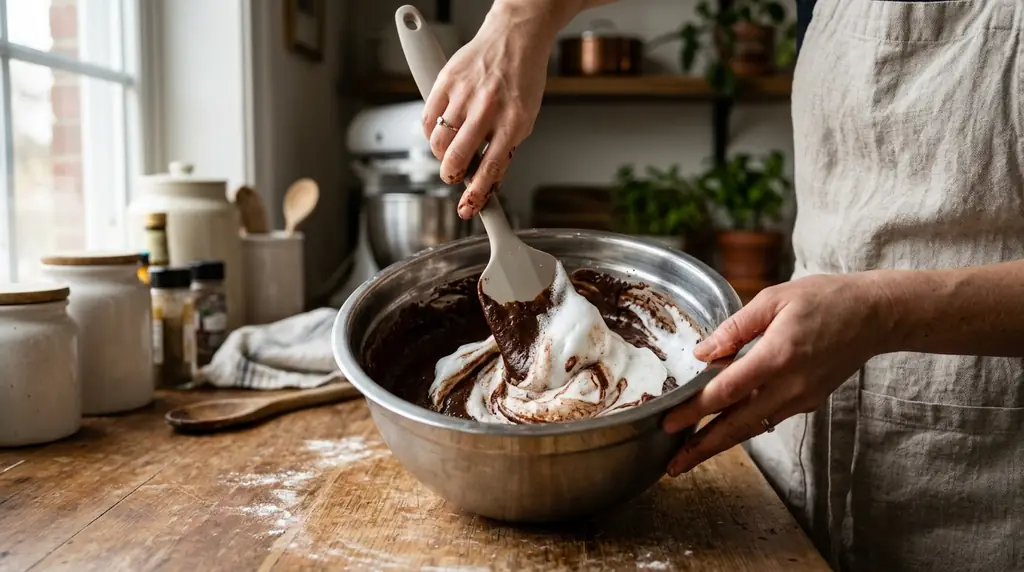
The Architecture of Air
When you vigorously whip egg whites, you are untangling their proteins and forcing them to form a complex, microscopic net that traps millions of tiny air bubbles. This foam is a structural marvel, capable of leavening heavy batters without any baking powder or baking soda.
However, this foam is incredibly fragile. If you take a bowl of stiffly beaten egg whites and aggressively stir them into a heavy cake batter with a wooden spoon, you will instantly pop all of those hard-earned air bubbles. The batter will deflate into a dense soup, and your soufflé will never rise. You must use a technique called "folding."
The Required Tools
Folding cannot be done effectively with a whisk, a fork, or a rigid wooden spoon.
- You absolutely must use a wide, flexible silicone or rubber spatula. The flexibility allows the tool to sweep the contours of the bowl without crushing the air bubbles against the glass.
- You need a mixing bowl that is significantly larger than the volume of your ingredients, as the folding motion requires sweeping arcs of space.
Step-by-Step Folding Technique
The goal of folding is to gently weave a heavy base mixture (like melted chocolate or dense cake batter) together with a light, airy mixture (whipped egg whites or whipped cream) using a very specific physical motion.
- Step 1: The Sacrifice. Never dump all the egg whites into the heavy batter at once. Take about 1/4 of the whipped egg whites and stir them vigorously into the heavy batter. This is called "sacrificing" the whites. It lightens the heavy batter, making it easier to accept the rest of the foam without collapsing.
- Step 2: Add the remaining whites. Gently scrape the rest of the stiff egg whites on top of the newly lightened batter.
- Step 3: The Position. Hold the spatula in your dominant hand. Imagine the mixing bowl is a clock face.
- Step 4: The Cut. Plunge the blade of the spatula vertically down the center of the bowl, cutting straight from the 12 o'clock position down to the 6 o'clock position, cutting entirely through the batter.
- Step 5: The Scoop. When the spatula hits the bottom at 6 o'clock, turn the blade flat, sweep it forcefully across the bottom of the bowl toward the 9 o'clock position, and scoop the heavy batter up and over the light egg whites on the surface.
- Step 6: The Turn. As you lift the batter over, use your non-dominant hand to rotate the bowl a quarter turn (from 12 to 9).
- Step 7: Repeat the rhythm. Cut down the middle, sweep the bottom, lift up and over, turn the bowl. Down, sweep, over, turn.
- Step 8: Stop immediately. Continue this gentle, sweeping motion only until no large streaks of white remain. Do not overmix. It is better to have a few tiny visible flecks of egg white than to deflate the entire batter.
Folding requires patience and a light hand. By mastering this gentle technique, you preserve the microscopic architecture of the foam, ensuring your baked goods rise to towering heights in the oven.