
Navigating the Dairy Aisle: Cream vs. Half-and-Half
Why did your pan sauce curdle? Why won't your whipped cream form peaks? The answer lies in the fat percentage of your dairy.
The Importance of Butterfat
Standing in the dairy aisle, looking at cartons labeled "Heavy Cream," "Whipping Cream," "Light Cream," and "Half-and-Half" can be deeply confusing. While they all look like thick milk, substituting one for the other in a recipe can lead to disastrous culinary failures.
The defining characteristic of all these products is their butterfat percentage. The amount of fat dictates two critical things: whether the liquid can trap air (whip into a foam) and whether the proteins will curdle (separate) when exposed to high heat or acidity.
The High-Fat Creams (The Whippers)
To successfully trap air bubbles and form stable whipped cream, a dairy product must contain at least 30% fat. Anything less will simply slosh around the bowl.
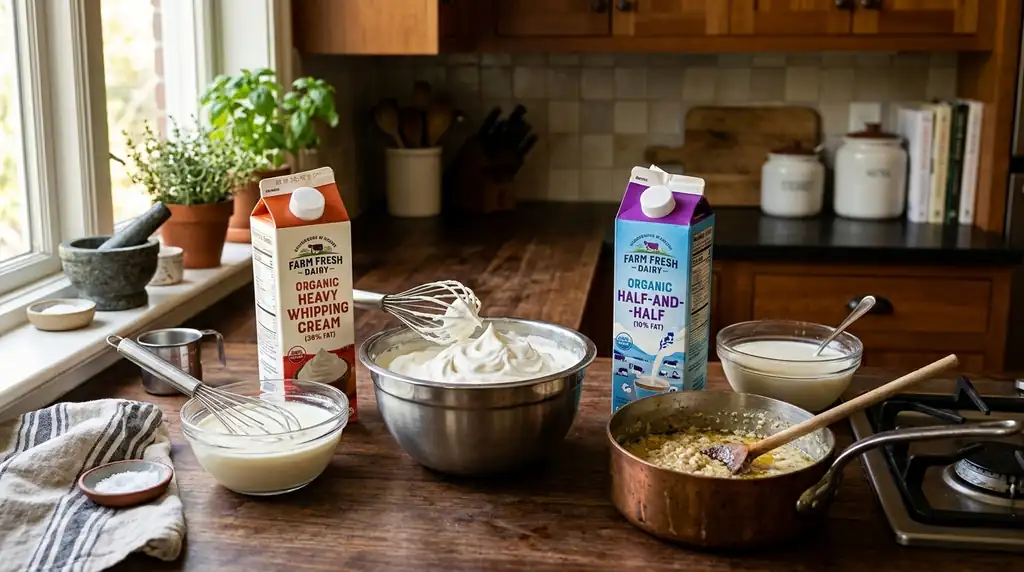
- Heavy Cream (or Heavy Whipping Cream): This is the richest option, containing at least 36% butterfat (often up to 40% in premium brands). Because of the massive fat content, it whips incredibly quickly into stiff, sturdy peaks that will hold their shape for hours on a cake. It is also completely immune to curdling. You can boil it aggressively or add lemon juice to it, and it will remain smooth and velvety. It is mandatory for rich pan sauces.
- Whipping Cream (or Light Whipping Cream): This contains between 30% and 35% butterfat. It will whip, but the peaks will be softer, lighter, and will deflate much faster than heavy cream. It is acceptable for a quick dessert topping, but less ideal for making stable frostings or boiling in sauces.
The Low-Fat Creams (The Curdlers)
These products lack the necessary fat to whip or to survive harsh cooking environments.
- Light Cream (or Coffee Cream): Contains between 18% and 30% butterfat. It is primarily used to add richness to coffee. It absolutely will not whip. If you add it to a boiling hot pan or a highly acidic tomato soup, the proteins will violently curdle, leaving you with a grainy, separated mess.
- Half-and-Half: This is literally a 50/50 mixture of whole milk and light cream, containing about 10% to 12% butterfat. It is excellent for pouring over cereal or enriching a cup of coffee, but it is useless for baking or sauce-making.
- Whole Milk: Contains 3.25% butterfat.
The European Exceptions
If you are cooking from a British or French recipe, you may encounter different terminology.
- Double Cream (UK): This is incredibly rich, containing 48% butterfat. It is so thick it can almost be spooned out of the bottle. It whips instantly, but is very easy to over-whip into butter.
- Crème Fraîche (France): This is heavy cream (30%+ fat) that has been inoculated with bacterial cultures, rendering it thick, tangy, and slightly acidic. Because of the high fat, it will not curdle when boiled, making it a luxurious addition to hot soups.
When a recipe calls for Heavy Cream, respect the fat. Do not try to save calories by substituting Half-and-Half, or your sauce will be ruined.