
Managing Leftovers: The 2-Hour, 4-Day Rule
Don't play Russian roulette with last week's chili. Master the strict time limits and temperature rules that professionals use to guarantee food safety.
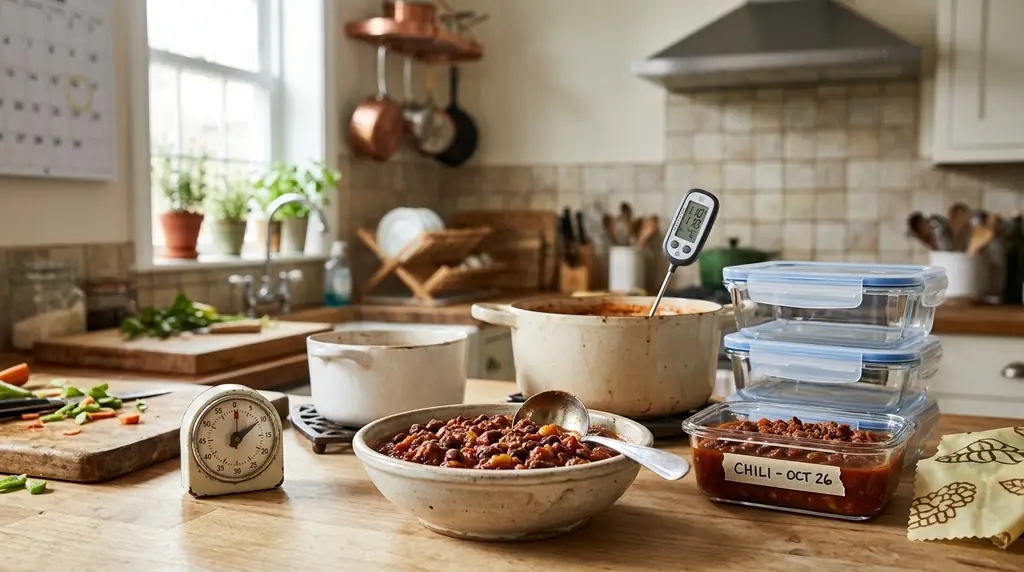
The Illusion of the Refrigerator
The refrigerator is a fantastic tool for preserving food, but it is not a time machine, and it does not stop biological decay; it merely slows it down. Many home cooks suffer from a dangerous misconception that as long as cooked food is in the fridge, it is safe to eat indefinitely.
Furthermore, many people rely on the "sniff test" to determine if a leftover is safe. This is a massive mistake. The bacteria that cause severe food poisoning (like Salmonella or E. coli) are completely odorless, colorless, and tasteless. If food smells sour or looks moldy, it is certainly ruined by spoilage bacteria, but food that smells perfectly fine can still make you violently ill.
The 2-Hour Rule (The Cool Down)
Food safety begins the moment the food finishes cooking.
- The Danger Zone: Bacteria multiply exponentially at temperatures between 40°F and 140°F.
- The Rule: You have exactly 2 hours (or 1 hour if the room temperature is above 90°F) to move cooked food from the stove or table into the refrigerator. If a pot of soup sits on the counter for 4 hours cooling down, the bacteria load has already exploded. Throw it away.
- The Rapid Cool: Do not put a massive, boiling hot stockpot of soup directly into the fridge. It will raise the temperature of the entire fridge, endangering everything else. Divide massive batches into smaller, shallow containers so they chill rapidly.
The 4-Day Rule (The Lifespan)
Once the food is safely in the refrigerator, the clock is still ticking.
- The Rule: Almost all cooked leftovers (meat, pasta, rice, vegetables, soups) have a maximum safe lifespan of 4 days in the refrigerator.
- Day 1 is the day you cooked it. By Day 5, the risk of foodborne illness increases dramatically, regardless of how it smells. Throw it out.
- The Exceptions: Seafood is highly perishable and should be consumed within 2 days. Highly acidic foods (like tomato sauce with no meat) can sometimes push to 5 or 6 days.
- The Freezer Extension: If you know you will not eat the leftover chili within 4 days, move it to the freezer immediately. Freezing halts the clock indefinitely.
The Reheating Protocol
When you pull leftovers out on Day 3, you must kill any bacteria that slowly grew in the fridge.
- You must reheat all leftovers to an internal temperature of 165°F (74°C). The food should be steaming hot all the way through, not just lukewarm in the center.
By adhering strictly to the 2-Hour/4-Day rule, you eliminate the guesswork and ensure your family's safety.