
How to Correctly Measure and Cut Parchment Paper
Stop wrestling with unruly rolls of parchment. Learn the professional techniques to line cake pans perfectly without creases or tearing.
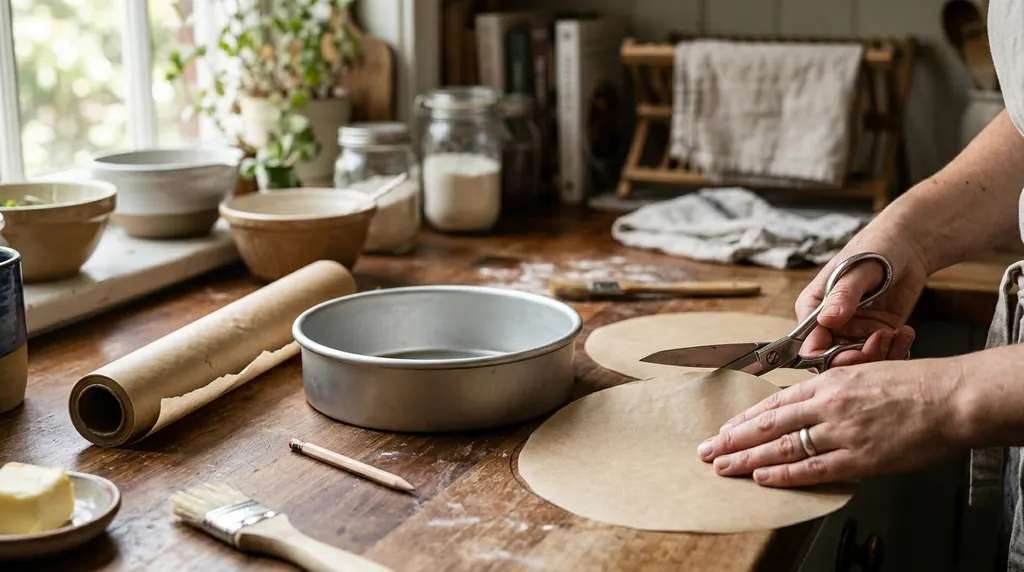
The Unsung Hero of Baking
Parchment paper is coated with a microscopic layer of silicone, making it entirely non-stick and heat-resistant up to 450°F. It ensures your delicate cakes release effortlessly from their tins and saves you from scrubbing burnt-on sugar off your baking sheets.
However, many home bakers struggle with parchment. They try to jam a square sheet into a round pan, resulting in massive, folded creases that bake directly into the side of the cake, ruining its appearance. Or, they struggle with paper that constantly curls back up on itself on a flat tray.
Step-by-Step: Taming the Curl on a Baking Sheet
Parchment comes tightly wound on a roll, giving it a stubborn "memory." Here is how professionals make it lay perfectly flat.
- Step 1: Tear off a sheet roughly the size of your baking tray.
- Step 2: Crumple the entire sheet into a tight ball in your hands. Yes, literally crumple it like garbage.
- Step 3: Unfold the ball and smooth it out onto the baking tray. By breaking the structural fibers of the paper, it instantly loses its memory and will lay perfectly flat without rolling up.
- Alternative Step: If you need a pristine, un-crumpled sheet (like for macarons), spray a tiny burst of cooking spray onto the corners of the baking tray and press the flat sheet down. The oil acts like glue.
Step-by-Step: The Perfect Round Cake Pan Liner
To line the bottom of a round cake pan, you do not need to trace it with a pencil. You use the folding technique.
- Step 1: Tear off a square of parchment slightly larger than the diameter of your cake pan.
- Step 2: Fold the square perfectly in half to create a rectangle.
- Step 3: Fold the rectangle in half again to create a smaller square.
- Step 4: Fold the square diagonally, bringing one corner to the opposite corner, creating a triangle.
- Step 5: Fold that triangle in half one more time to create a very narrow, sharp dart.
- Step 6: Flip your cake pan upside down. Place the sharp point of the folded dart exactly in the dead center of the pan.
- Step 7: Look at where the edge of the pan intersects the wide part of your folded paper. Use scissors to cut straight across the paper at that exact mark.
- Step 8: Unfold the paper. You will have a geometrically perfect circle that fits flawlessly into the bottom of your pan without a single crease.
When to Use Wax Paper Instead
It is crucial to never confuse parchment paper with wax paper.
- Wax paper is coated with paraffin wax. If you put it in a hot oven, the wax will melt, smoke, and potentially catch fire, ruining your food.
- Use wax paper strictly for cold applications, such as wrapping sandwiches, layering between freezing hamburger patties, or lining a countertop when rolling out sticky pastry dough.
Mastering these simple geometric tricks eliminates the frustration of sticky pans and guarantees a professional, flawless finish to your cakes.