
How to Make a Perfect Roux: The Foundation of Sauces
A roux is the magical thickening agent behind everything from a classic mac and cheese to a rich Louisiana gumbo. Master the technique and unlock a world of velvety sauces.
What Exactly is a Roux?
In classical French cuisine, a roux (pronounced "roo") is a thickening agent created by cooking equal parts by weight of fat and flour. It is the architectural foundation of three of the five French Mother Sauces (Béchamel, Velouté, and Espagnole), as well as countless gravies, soups, and stews.
If you were to dump raw flour directly into a hot liquid, the exterior of the flour clumps would instantly gelatinize, creating a waterproof seal around dry powder. You would end up with a sauce full of disgusting, doughy lumps. A roux solves this problem by coating every single microscopic flour particle in fat, allowing it to disperse evenly into liquid without clumping.
The Three Stages of Roux
The longer you cook a roux, the darker it becomes, the more the flavor changes, and—crucially—the less thickening power it retains.
- White Roux: Cooked for just 2 to 3 minutes, just long enough to cook out the raw flour taste. It remains pale white and has maximum thickening power. Used for white sauces like Béchamel (macaroni and cheese).
- Blond Roux: Cooked for 5 to 10 minutes until it takes on a pale golden color and a nutty aroma. Used for Velouté (chicken pot pie filling).
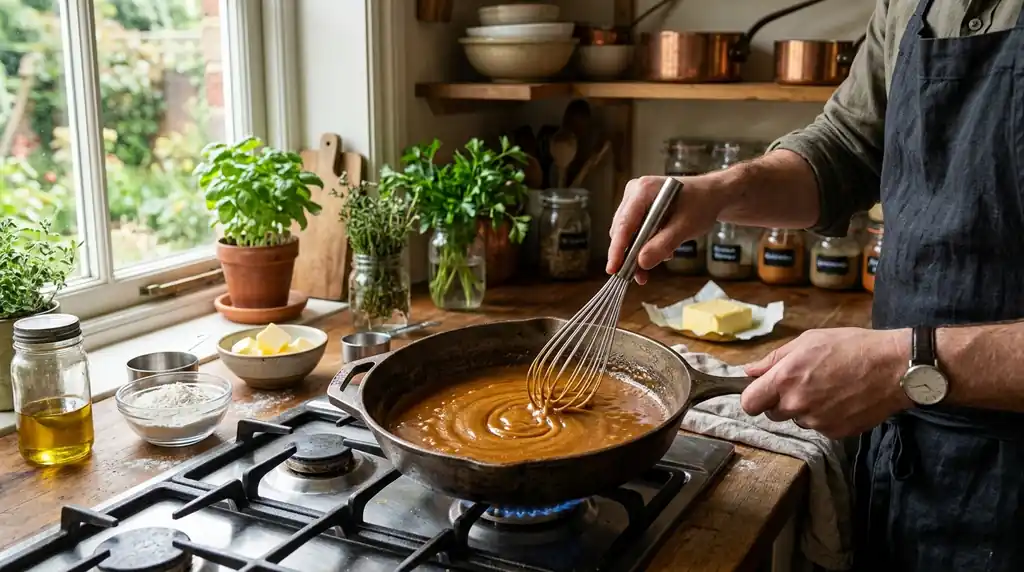
- Brown/Dark Roux: Cooked for 20 to 45 minutes until it resembles the color of dark chocolate. It has a profound, toasted, complex flavor but very little thickening power. This is the cornerstone of Cajun and Creole cooking, particularly Gumbo.
Step-by-Step: Making a Flawless White Roux
Making a roux requires constant attention. It can go from perfectly blond to bitterly burned in a matter of seconds.
- Step 1: Measure equal parts fat and all-purpose flour by weight (e.g., 50 grams of butter and 50 grams of flour). If measuring by volume, roughly 3 tablespoons of flour per 3 tablespoons of fat works well.
- Step 2: Place a heavy-bottomed saucepan over medium-low heat. Add your fat. For a white roux, unsalted butter is the standard.
- Step 3: Once the butter is completely melted and bubbling slightly (but not browning), sprinkle the flour evenly over the surface.
- Step 4: Immediately begin whisking continuously. The mixture will quickly come together into a thick, bubbly paste.
- Step 5: Keep the heat low and continue to whisk for exactly 2 to 3 minutes. You will smell the aroma shift from "raw dough" to a slightly sweet, toasted scent. It should look like wet sand.
- Step 6: The liquid addition. The golden rule of roux is: Hot roux, cold liquid (or cold roux, hot liquid). While whisking rapidly, slowly pour in your cold or room-temperature liquid (like milk for a Béchamel).
- Step 7: Keep whisking until the mixture comes to a gentle simmer. A roux reaches its maximum thickening potential right when the liquid hits a boil. Reduce the heat and let it simmer for 5 minutes to fully mature the sauce.
Troubleshooting and Tips
If your sauce breaks or clumps, you likely committed one of these common errors.
- If your sauce is lumpy, you either added hot liquid to a hot roux, or you dumped all the liquid in at once instead of a slow, steady stream.
- If your sauce tastes like raw flour, you did not cook the paste long enough before adding the liquid.
- For dark roux, butter will burn. You must use a fat with a high smoke point, such as vegetable oil, clarified butter, or rendered bacon fat, and whisk constantly for 30+ minutes.
Understanding how to manipulate fat and flour opens the door to creating rich, luxurious, professional-grade sauces entirely from scratch.